The Science Behind Beauty: How Butterfly Wings Shimmer
Have you ever seen a butterfly so shimmery and iridescent that it looked otherworldly? Like something you might be hallucinating? Butterflies that seem too vibrant, too perfect and far too magical to exist. Well, they're not all fantasy or AI generated images! Some of the most vivid, glistening wings are indeed real. Today we're diving into the physics behind that shimmer, and how the science of butterfly wings has helped shape the technology we use everyday.
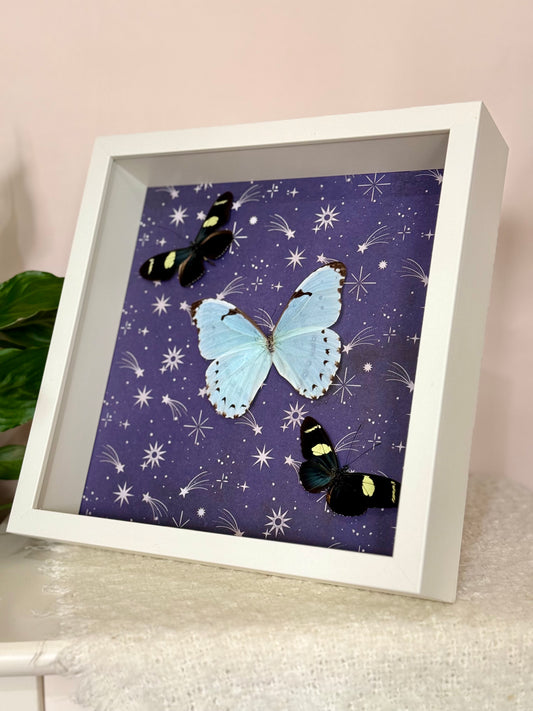
 The Adonis Morpho has a metallic glow that barely looks real!
The colour we see on butterfly wings is an interesting phenomenon. Rather than the wings themselves containing pigment, the colour we see is actually structural. Most colours in the world around us come from pigmentation, where chemical compounds absorb certain light wavelengths and reflect others. There are different wavelengths for every colour in the visible spectrum. For example, a red apple absorbs most wavelengths of light but reflects the red wavelength back to our eyes.
Structural colour works in a completely different way. Instead of absorbing and reflecting wavelengths, it bends, bounces, and scatters the wavelengths off it's surface. This interaction can concentrate, filter and separate light, producing bright, iridescent colours. It also causes the colour to shift and shimmer when viewed from different angles. Structural colour is responsible for some of the most striking visuals in nature, including peacocks, hummingbirds, Siamese fighting fish, chameleons and even materials like mother of pearl shell and opal gemstones. The 'structure' behind this effect comes from the presence of tiny, microscopic scales covering the wings and often the body of the butterfly. These scales overlap, like tiles on a roof, and each one has multiple layered ridges and cross-ribs that act as photonic crystals. In simpler terms, their physical structure enables the flow of light to be controlled and manipulated, creating the dazzling shimmer we can see. Interestingly, if we rubbed all the scales from the butterfly wings, they'd actually be transparent!
 A magnified view of the scales on a butterfly wing
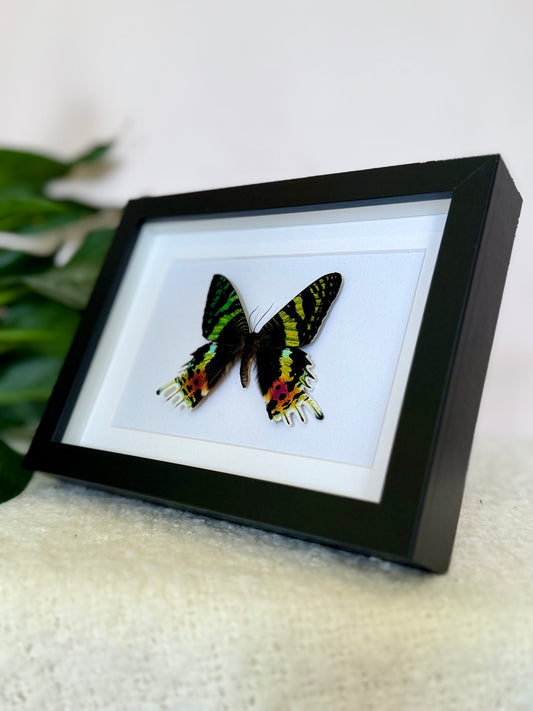
Butterfly wings have been a subject of study for centuries, not just for their aesthetic beauty but for their remarkable aid in scientific discoveries! The same incredible structure that allows for such amazing colour is also useful for developing bio-inspired technologies, from anti-counterfeit materials to explosives detectors! If you live somewhere like Australia or Canada, you may have noticed that banknotes feature cool hologram-like images, designed to be very hard to replicate. This technology was created with the help of the vibrant blue Morpho butterfly. Scientists replicated the nanostructure of the butterfly’s wing scales to embed unique optical identifiers into banknotes, creating security features that are virtually impossible to copy. Butterflies have also influenced the next generation of highly efficient solar panels. By mimicking the intricate nanostructures found on butterfly wings, researchers can better control how light is scattered, reflected, and absorbed as it hits the panel, significantly improving energy efficiency. The US military has shown particular interest in bio-mimicry for detecting dangerous vapours. Butterfly wing scales can trap explosive gases, altering the way light reflects from their surface, thus changing the optical output. This technology is being utilised to create small, low cost explosives detection sensors. This colour change effect can even be observed at home: the green Madagascar Sunset Moth often turns orange when exposed to acetone, then returns to it's original shimmery green once dry.
 The Sunset Moth's colours can change dramatically when exposed to gases.
Butterfly wings are far more than delicate decorations. Their shimmering beauty is the result of precise natural engineering, containing structures so complex they have paved the way for bio-inspired technologies, from secure banknotes to advanced solar panels. By understanding how light interacts with these intricate wing scales, we gain insight into both the elegance of nature and its practical use for society. What appears magical at first glance is, in reality, a remarkable fusion of physics and biology.